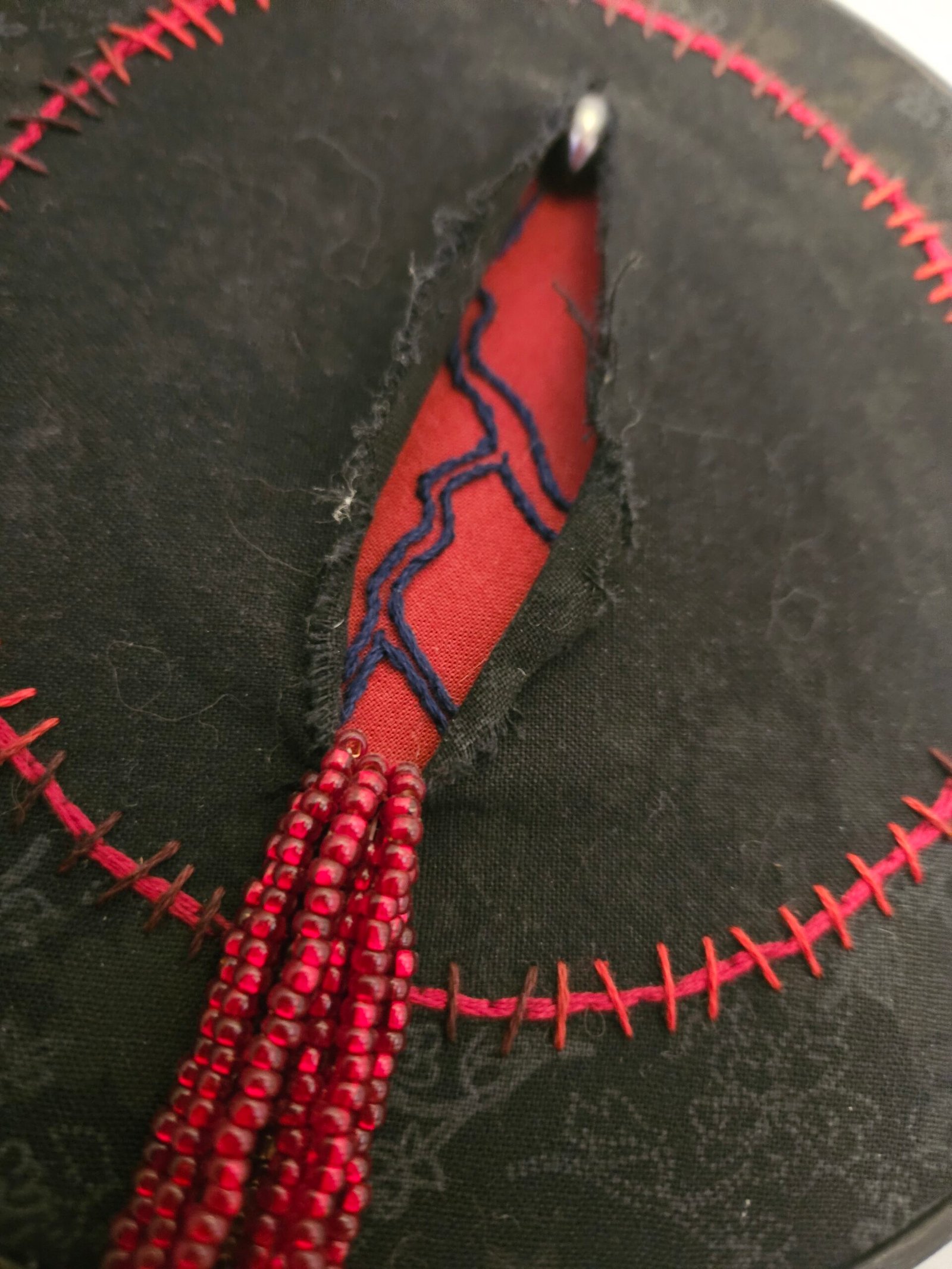
 Human Enough
Written on October 22, 2026 by gradientdescent
Tags: appalachian, gore
The first thing it steals is a face.
It’s not unusual for someone to go missing in Regent’s Landing, or even to die. It’s not a small town; people come and go, run away, and sometimes never come back. It’s tragic, but it’s nothing special. Somebody, somewhere, is lost every day. What is unusual is that when this one is found, his skin has been peeled off from his hairline to his throat.
Rachel is the last person to see him. She’s walking home on Thursday like she does every work night, cutting through the wooded park between her apartment and the pharmacy. She likes this path because it’s quiet. Secluded. Dark in a way that few places in the city really are. Just a few paces in, the path dips into a little valley, and the trees grow in so thick that for half a mile all the lights and sounds of the city vanish. For fifteen minutes, she can almost imagine she’s completely cut off from the rest of civilization.
Though it’s barely half past five, it’s so dark already that she doesn’t see him till she’s inches away. A cluster of shadows suddenly resolves into the features of a man peeking out from the trees. She jumps back with a cry and, in a rustle of leaves, he vanishes. She’s left with only the brief impression of a young man’s pale, round face.
Rachel isn’t scared, only startled. It was probably just a vagrant. Sometimes they pitch tents in the gully, leaving behind garbage that she’ll clean up from time to time. They’re just people minding their own business. Nothing to be afraid of.
But there’s something disquieting about the face she’s just seen that she can’t quite put her finger on. It’s not till she’s walking up the steps to her apartment that she realizes what it is. In the moment she’d seen him, the light of the moon had touched his features, highlighting the curve of his cheeks, the contours of his nose, the arc of his chin. But though wet, half-parted lips gleamed, no light reflected in his eyes. What should have been twin points of moonlight were dead, matte voids.
She’s on her break from the pharmacy desk the next day when she sees one Daniel Choi’s death reported on the local news. It’s not unusual for someone to go missing in Regent’s Landing, or even to die. But there’s something different about the way the police talk about this one. Something they’re very carefully not saying. And when they show Daniel’s photograph, his pale round face alive and smiling, she realizes it’s the man she saw on Thursday night.
This is notable only because one fact the report states quite clearly is that Daniel Choi died on Wednesday morning.
A face alone isn’t enough to make it human, it discovers. It could smell it in the tart chemicals her body released when she caught a glimpse of it in the moonlight. But the essence of a successful disguise eludes it. It can’t intuit the differences between it and her human companions that are significant, their bodies and minds too alien for it to comprehend analytically. So it studies.
“I tried making it without the lady fingers, but the texture just wasn’t the same.”
“In through the front door, wrap around the back…”
“Hand me those scissors, will you?”
“You’ve been sleeping together since the first date but holding hands is a bridge too far?!”
“It’s sugar, cream, and booze, I’m still gonna eat it anyway.”
“…Out through the back door, and off hops Jack.”
Warm and happy in the back room of a bookstore, Rachel relaxes with her friends. They laugh and joke and pass each other tea and snacks as they sew. One of them is teaching her how to knit, putting their hands on hers, guiding her through the steps of looping and knotting the yarn into itself. She’s too focused on repeating the motions to join in with the rest of the knitters’ chatter.
There’s no sign she’s given the face in the woods a second thought. She hasn’t even mentioned it to her companions. But it’s found a way to fold itself into the cracks and seams of the building.
Invisible, it watches Rachel set aside her knitting to help another woman fit a pattern, wrapping a tape measure around her body in a half-dozen places and recording the measurements diligently on the back of a paper pattern envelope. A plump, red-cheeked person slips their hand into a half-finished glove and wiggles their fingers playfully. A young man refills the tea cups, smiling warmly as he serves his friends. It studies these acts with single-minded interest.
The afternoon draws to a close and the group rises to leave, bidding goodbye to each other with hugs, with waves, and in one case with a playful shoulder punch. It analyzes each action intently. Observing the interplay between actor and subject. Committing the mechanics to memory. Watching. Studying. Planning.
When the next bodies are found, there’s two of them, sprawled at the foot of a leafless tree just off an ill-used maintenance trail. Their hands are severed, each in a different place, with a different technique, as if something is experimenting. Trying to find the right way to take them apart.
When a junior officer voices this interpretation, his sergeant laughs and tells him he’s been watching too many movies. But it’s an uncomfortable laugh. A little too loud, a little too brash. He’s trying to hide the fact that for the first time in his career he’s feeling light-headed looking down on a crime scene. And before he can get it under control, his vision starts to swim. He can’t hear his own voice over the ringing in his ears as he mumbles an excuse and staggers away.
Cool water. Blooming flowers. Raindrops on roses and whiskers on kittens. Think about anything but those two maimed bodies with their bloody stumps and the strands of viscera trailing out of their mangled forearms. Anything but their gaping mouths. Anything but the BLOOD.
Water. Flowers. Kittens. One breath at a time the knot between his shoulders relaxes. Eyes locked on his shoes, his vision slowly clears. The ringing in his ears fades; he can hear the voices of his colleagues behind him, the murmur of civilian onlookers penned behind the cordon. He’s fine. It’s only been a minute. If he’s lucky, nobody’s even noticed.
Then he hears something else. A rushing of wings. An avian cry. A soft, wet tearing sound. When he looks up from his feet, he meets the sight of a massive buzzard greedily pecking at the eyes of another mutilated body, and now he really does pass out.
By the time he comes to, his colleagues are already swarming around him. One of them dabs a handkerchief at his forehead, while others are frantically moving the cordon, pushing back the crowd, trying to hide the third corpse from the audience before someone snaps a picture. It’s a futile effort. Before they can clear out the onlookers, everyone’s caught a glimpse of the thing that sent the sergeant into a dead faint.
The arms of this corpse have been precisely severed at the shoulders, joints neatly removed from the sockets and skin peeled away from its chest to carefully extract muscle and tendons at the root. The coroner’s report records in dry, detached language that the victims were alive while their first limb was removed, but not, of course, the second. None of the severed limbs are ever found.
The news report is lurid enough that everyone in the pharmacy is talking about it the next day. One of the junior techs found a copy of the photographs before mod teams across the web scrambled to delete the grisly images, and over the afternoon break Rachel catches him sharing them with their coworkers. Something in the glee with which he’s talking about the photos stirs disgust inside her.
“Put that away Clive. Those are real people.”
His expression instantly drops at the ice in her voice. Ashamed, he shoves his phone back into his pocket.
Rachel’s pulling on her jacket at the end of her shift when her manager flags her down.
“You sure I can’t give you a ride home tonight?”
She composes her face into a careful mask of pleasantry. “That’s awful thoughtful Roger, but I’m all good.”
Uninvited, he follows her towards the door. “You’re not still walking through Braker Park alone, are you? Can’t have my top pharmacy tech getting nabbed by the body snatcher.” He’s making light of it, but he’s hovering just a little too close for her comfort.
He’s still talking by the time she’s buttoned up her coat, pulled on her hat, and slung her purse over her shoulder. Even when she’s standing halfway through the automatic doors and the cold air is blowing right into the pharmacy, he’s still trying to convince her to accept an escort back to her apartment.
“Pretty sure the ‘body snatcher’ is just a bear. Don’t you worry about me.” Surely he’ll give up if she keeps walking into the parking lot–but nope, no, he’s still following her right up to the edge of the sidewalk.
“You know, my cousin’s got a car he’s selling. I could get him to give it to you for the trade-in value.”
“I’ll give it some thought.”
He doesn’t so much as let her go as finally give up when she hits the sidewalk and he can’t follow her without technically leaving the property in the middle of his shift. It’s a relief when she ducks down the dirt path into the park and the pharmacy quickly dips out of sight.
It’s the same old forest path as always. No more dangerous than it was yesterday, no matter what Roger and Clive and everyone else fixating on that sensationalized news story want to say. People get hurt all the time. She sees it even when it doesn’t make the headlines, in the prescriptions for opioids and antibiotics and tetanus boosters she fills every day. Just because one of them made the news today doesn’t make it any more common than it was before. That’s just basic statistics. Basic statistics say that Roger is more likely to assault her than a bear. And that’s not just because the bear odds are exceptionally slim, she reflects with chagrin.
Still, as she ambles down the trail lit only by her pocket flashlight, the image of the mutilated body on Clive’s phone returns unbidden to her mind. She’d only glimpsed it for a moment, accidentally, before she tore her eyes away. But it was long enough to burn into her brain. A man’s body, shirtless, splayed face-up in the leaves. A pile of something wet and red by his feet. The shocking flash of gristle and gore that’s so wrong that she didn’t even comprehend it as his flayed chest until afterwards.
She wishes she’d never seen it.
A loud crack jolts her out of her head. Bare twigs just scrape her jacket as a branch comes crashing down in front of her and she jerks back, sending her flashlight flying. All the logic in the world doesn’t stop the jolt of adrenaline that shocks her cold. Heart racing, she freezes.
It’s dark. It’s bitterly cold. She can’t see the branch or the path or the forest, and the only sound she can hear is her blood rushing in her ears. It feels like too long before her pulse starts to slow again and the sound of her heartbeat fades back to background noise.
There’s no need to panic. She’s just a little on edge. Probably thanks to Roger doing his best to scare her into going home with him. Or maybe those sick pictures.
But even though she knows she shouldn’t be afraid of the dark, she is. As she stands there fighting a tremor in her hands, she realizes it’s not just the dark. It’s the silence. No birds. No insects. No rustle of leaves.
It fears its newfound appendages aren’t enough. But it’s eager to test its new toys. And it’s been studying so hard. It’s certain it knows what to do.
It looks at Rachel, standing there paralyzed in the dark. It wants to reach out and hold her hand. If it’s going to risk it, now is the time. So it slowly extends one of the several human hands at its disposal. Just as it’s seen before. Elbow extends. Wrist rotates. Tendons draw back, then relax forward.
When she feels fingers wrap clumsily around hers in the dark, she recoils in terror. Heart in her throat, she flees, frantically rifling through her purse till she finds her phone. In its weak light, she runs the rest of the way home.
From that point on, she no longer walks through the forest at night.
Now it studies her intently, analyzing, searching. There must be more to this than just pressing bits of meat together. Something more complicated. More subtle.
It folds itself into the roots of her home. Snakes its way into the drains. Squeezes into the gaps between her windows. Its new appendages are a bit of a challenge to hide, but it manages. Humans inspect the contents of dark basement corners far less often than they should, it discovers.
She’s not going out as often as she used to. Many people aren’t, for some reason it doesn’t care to understand. But it’s not interested in what anyone else is doing. Only her.
Now she hurries home at the end of every day in a run-down car. She still spends Sunday with her knitting circle, but it’s been two weeks since she’s gone anywhere after dark.
Even so, she still finds ways to surround herself with human contact. And not just the brisk, superficial kind of contact she shares with her customers every day at the pharmacy. Human warmth. Human love.
It sees her talking for long hours in the evenings through her computer, sharing intimate connections with people she knows only as a voice on the other side of a computer screen. And this baffles it, for when IT makes disembodied sounds, every person who’s ever heard it has reacted with some form of animal anxiety.
But here she is, listening to voices out of nowhere, smiling, laughing, talking in return. And she doesn’t just talk: her body warms with the same chemical reactions that suffuse it when her friends sit right at her side, emits the same sweet little hormone cocktails it longs to taste on what one might, for lack of a better word, call its tongue.
Could it be so simple? Is that all that it takes?
It takes a few nights of observation to figure out the mechanics of the arrangement. But it is nothing if not a masterful mimic.
The two bodies that appear next are barely damaged at all, compared to the carnage of the previous corpses. The only wound they bear is a clean vertical slit up their throats. It’s so neat and precise, all the blood wiped away and the skin folded closed again, that it isn’t until the autopsy that it’s discovered that inside their throats have been hollowed out and their vocal cords removed.
She keeps talking to them on voice chat for five days after their bodies are discovered before she realizes that her friends have been dead nearly a week and blocks them, horrified.
It’s growing frustrated now, impatient. Can it not yet pass as a human long enough for her to look at it once without flinching in disgust? All the things that people seemed to use to construct themselves–their face, their touch, their voice–proved inadequate to disguise itself for more than a fleeting moment. Perhaps it just hasn’t found the right face. The right voice.
Or perhaps there was some crucial element of humanity it’s overlooked. Something so deep inside they take it for granted. Something hidden that lights the essential spark that they instantly see in each other, the spark they instantly know that it does not have.
But there’s nothing they can bury so deep that it can’t cut out.
Its hunts escalate in volume and ferocity. Bodies are found mutilated beyond recognition; the police no longer share descriptions of their wounds and fall back on clinical euphemisms. Far more people are reported missing than are found. The city is on edge and its inhabitants are all, justifiably, terrified. Nobody goes out alone at night anymore.
She’s at home when her phone rings at 8:45 PM. The caller ID says it’s Clive.
“Rachel? Thank god you picked up.”
There’s an edge in his voice she’s never heard before. “What’s wrong, Clive?”
“It’s my car, I got a flat on the way home, and there’s no way in hell I’m going out in the dark to change a tire. I’m so sorry, I tried calling like five other people first…”
“Wow, I’m all the way down at number FIVE?” She hears something like panic creeping into his voice, so she keeps her tone light and easy. But she’s already pocketing her car keys. “I think I’m insulted.”
“Look, could you please just come pick me up?”
“Hang tight, I’ve got you. Send me the address and I’ll be there in ten.”
The location he texts her is further than she expected. Out of the city, off the highway, down a country road, and miles away from the last street light. She almost speeds right past Clive’s car in the dark. Just in time, her headlights glance off the little sedan, half in the gulley at the side of the road. In spite of her promise, it’s more like twenty minutes before she’s pulling over behind his car.
But Clive’s not there. Dead grass crunches under her feet as she approaches the vehicle, guided only by the light of her pocket flashlight. The door’s ajar. The car’s vacant.
She’s about to lean in to the car to look for his phone, for his keys, for a note, for any sign of the young man.
If she had, she’d have seen the blood. The scratch marks. The fractured glass. She’d have called for help. She’d have run.
But she doesn’t. Because just as she’s about to peer in, she hears his voice.
“Rachel? Are you there?” It sounds distant, coming from somewhere inside the woods. And there’s that same edge she heard over the phone. Shaky. Scared.
“Clive! Come here! I’ve got the car, let’s go.” She sweeps her flashlight across the woods, but there’s no sign of him.
“I… I can’t.” The tremor in his voice is getting stronger. “I need your help. I can’t move.”
She’s already pushing through the woods towards his voice. “Keep talking, I’m coming to get you.” It’s slow going through the thick underbrush. Branches claw and scrape at her as she struggles towards his voice.
“What should I say?” The words sound like he’s struggling to get them out.
The ground slides underfoot and she barely catches herself from slipping on a patch of decomposing leaves. She tightens her grip on the flashlight. “How about you tell me why you walked out here in the dark like a dumbass?”
There’s something resembling laughter in return. “I thought… you wouldn’t come. I had to try…” He trails off, and a little spike of fear grips her now. He sounds almost delirious. How badly is he hurt?
Her feet skid and she barely catches herself from sliding down an embankment, latching on to a withered sapling just in time to keep herself from tumbling. If she’s not careful she’ll end up just like Clive. She has to reach him, though. She can’t leave him alone. She has to keep moving towards the sound of his voice.
It’s taken on an almost dreamy tone now. “I didn’t think you would come. Nobody else comes when I call. No matter how hard I try.” He’s closer. But she still can’t see him. She casts around with the flashlight. Its tiny beam can only light up one patch at a time, little pieces of the whole. A pale tree trunk. A haggard bramble. Spindly, leafless branches. Black, wet, rotting organic matter underfoot. And the hollow maw of a limestone cave, from which Clive’s voice pleads.
“Rachel?”
There’s a shift in his tone that sends a chill straight to her heart.
“I need your help.”
Slowly, she raises her flashlight towards the sound of the trembling voice.
“I can’t move.”
She doesn’t know what she’s seeing. Her brain can’t make sense of the thing slumped on the cave floor. It has to be a thing. This can’t be a person, it can’t be a man with a name who she sees every day. But the longer she looks at it, the more it comes in to sickening focus, till she can’t deny what’s in front of her anymore.
She sees limp, flaccid limbs. White, glistening globs scattered carelessly across the ground at its thighs. A bowl of bone and blood and hair propped up in deathly pale hands. A mouth, stained with blood, now moving mindlessly as words spill out of it, “I can’t move” chanted over and over and over in an unceasing loop as if it’s the last and only thought left inside this husk of meat and bone.
Black tendrils are buried deep into what’s left of the exposed brain, what parts haven’t been sliced out and tossed aside like so much useless gristle. As she stares, frozen, they twitch and worm just a little bit further, plunging between the quivering grey folds until the eyes bulge in their sockets and fluid spills down ashen cheeks in blood-tinged rivulets.
She should be terrified, she should be running. But instead she’s hypnotized, transfixed, unable to look away as another tendril creeps from the darkness and joins the others. With a gentle, almost delicate caress, it slithers across the contours of exposed tissue, licking and stroking and probing as the body beneath it twitches and spasms in reponse. Then with a decisive thrust, it buries itself deep in the ravaged organ. Abruptly the chanting stops. His lips fall still, half-parted, cut short mid-plea.
And then she sees it. All of it.
It’s put everything it has into this moment. Every stolen tool it has at its disposal. Every sequence of muscle contractions and chemical mimicry it’s committed to memory.
It waves with a friend’s hand to beckon her closer.
It smiles with a friend’s face to put her at ease.
It dulls her fear with hormones excreted from a stolen endocrine system, knit together from the glands of a half dozen human bodies.
When she takes one shuffling step forward, its arms open wide to welcome her. Every last one of them. And at last, it lumbers forward too, exposing its whole, monstrous self in the moonlight.
It’s an amalgam of insectoid limbs, held together by slick membranes that grow out to meld with the nerves and vessels of the human parts it’s attached to itself. Five faces. Six pairs of vocal cords. Thirteen arms, eight legs. Fifteen eyes, only some of them socketed behind faces. An excess of genitals of all sexes, engorged by human circulatory systems extracted from their hosts and strung up like bloody, throbbing Christmas lights.
It knows the answer already from the look on her face. But it needs to hear her say it anyway.
Am I human enough yet? it asks.